


The global shift toward Electric Vehicles (EVs) creates new challenges for the automotive supply chain. Unlike traditional cars, EVs require lightweight materials that must also withstand immense torque and battery weight. Consequently, engineers are turning to advanced 5-axis milling to produce critical structural parts. This technology allows for the creation of complex shapes without compromising the internal strength of the metal. Most importantly, precision CNC automotive components made via 5-axis machining offer superior durability compared to 3-axis alternatives. In this guide, we explore how multi-axis movement enhances the mechanical properties of EV parts. We will help you understand why 5-axis milling is the gold standard for high-performance electric mobility. Let us dive into the future of automotive precision.
The Evolution of Machining for Electric Mobility
Electric vehicles demand a higher level of structural integrity for their chassis and drivetrain components. Standard machining often leaves weak points where multiple setups meet on a single part.
Eliminating Alignment Errors
A 5-axis machine moves the cutting tool across five different axes simultaneously. This allows the machine to finish a part in a single setup. Therefore, you eliminate the “stack-up errors” that occur when moving a part between different fixtures. For precision CNC automotive components, this means every hole and face aligns perfectly. This perfect alignment is vital for EV battery housings and motor mounts.
Optimizing Tool Engagement
5-axis milling keeps the cutting tool at an optimal angle to the surface at all times. This constant contact reduces “chatter” and tool vibration during the manufacturing process. As a result, the internal grain structure of the metal remains more stable and uniform. This uniformity directly translates to a stronger finished product that can handle high-stress environments.

Enhancing Structural Integrity Through Complex Geometry
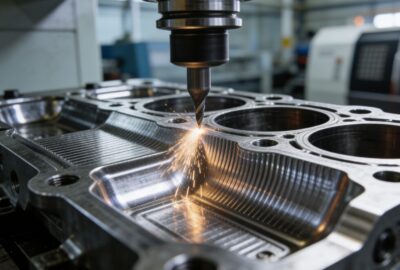
Modern EV designs often feature organic, topologically optimized shapes to save weight while maintaining strength. 5-axis milling is the only way to produce these complex geometries with high precision.
-
Continuous Tool Paths: Smooth transitions between surfaces prevent stress concentration points in the metal.
-
Deep Cavity Machining: Shorter, stiffer tools can reach deep areas by tilting the table or spindle.
-
Improved Surface Finish: Superior finishes reduce the risk of “micro-cracks” that lead to long-term fatigue.
-
Undercut Capabilities: Machining complex internal features allows for integrated cooling channels in EV power units.
These features allow designers to create precision CNC automotive components that are both lighter and stronger. In the EV world, reducing weight directly increases the driving range for the end user.
Expertise in High-Performance Alloys
Machining high-grade aluminum and titanium requires deep metallurgical expertise. 5-axis experts understand how “heat soak” during machining affects the strength of the final component. A trustworthy supplier will use “Adaptive Clearing” strategies to manage thermal loads effectively. This expertise ensures that the precision CNC automotive components meet the strict safety standards of the EV industry.
Authoritative Quality Control Standards
Trustworthy manufacturers utilize 5-axis CMM (Coordinate Measuring Machines) to verify every dimension. Look for suppliers who hold ISO 9001 and IATF 16949 certifications for automotive quality management. These “Authoritative” credentials prove that the factory follows rigorous testing protocols for every batch. Reliability in testing leads to total confidence in your vehicle’s structural safety.
The Strategic Importance of Surface Integrity in EVs
Surface integrity is about more than just a shiny look; it is about mechanical performance. In EVs, parts often face high-frequency vibrations from electric motors.
Reducing Fatigue Failure
5-axis milling produces a much smoother surface profile compared to 3-axis stepping. This smoothness prevents the formation of “stress risers” on the surface of the component. Consequently, the precision CNC automotive components can endure millions of vibration cycles without cracking. This durability is essential for suspension links and steering knuckles in heavy electric SUVs.
Consistent Tolerance Control
Maintaining tight tolerances across a large part is easier with 5-axis technology. Since the part does not leave the fixture, the spatial relationship between all features remains fixed. This consistency ensures that every bolt fits perfectly and every seal holds tight under pressure. High precision leads to a quieter, safer, and more efficient electric vehicle experience.

Boosting Production Efficiency for the EV Market
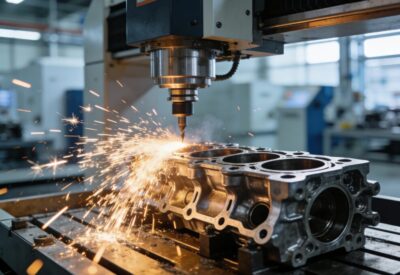
The EV market moves fast, and manufacturers need to scale their production quickly. 5-axis milling provides a significant “Efficiency” boost to the entire supply chain.
-
Reduced Lead Times: Finishing a part in one setup saves hours of manual labor and movement.
-
Lower Fixture Costs: You need fewer custom jigs and fixtures when the machine can tilt and rotate.
-
Material Savings: Advanced 5-axis paths allow for thinner walls without sacrificing the part’s rigidity.
-
Higher Throughput: Faster setups mean more precision CNC automotive components leave the factory every day.
These efficiencies allow EV startups to bring their products to market much faster. Furthermore, lower production costs help make electric vehicles more affordable for the general public.
Common Myths About 5-Axis Machining in Automotive
Despite the benefits, some misconceptions still exist regarding the cost and complexity of 5-axis milling. Let us clarify two frequent myths in the industry.
Myth 1: 5-axis milling is too expensive for automotive parts. While the machine cost is higher, the “Total Cost per Part” is often lower. You save money on labor, fixtures, and secondary finishing processes. For high-end EVs, the performance gains far outweigh the initial investment.
Myth 2: 3-axis machining is just as strong for simple parts. Even for simple parts, 5-axis milling provides better tool orientation. This results in a superior grain structure and surface finish. Therefore, the precision CNC automotive components are almost always structurally superior when made on a 5-axis machine.
Maintaining Trust Through Material Traceability
In the automotive world, knowing the history of your metal is vital for safety. A professional CNC supplier provides full material traceability for every order.
This includes mill test reports that verify the chemical composition and strength of the raw material. When combined with 5-axis precision, this data provides a complete “Trustworthiness” profile for the part. If a failure ever occurs, you can trace the issue back to the specific batch of metal. This level of transparency is a core requirement for modern EV manufacturers.

Precision That Drives Innovation
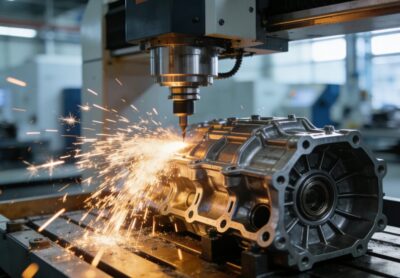
5-axis milling is no longer an optional luxury for the automotive industry. It is a necessary tool for building the next generation of safe, efficient electric vehicles. By improving structural integrity and reducing weight, this technology powers EV innovation. Precision CNC automotive components benefit from superior alignment, better surface finishes, and consistent grain structures. As the EV market grows, 5-axis machining will remain at the heart of high-performance manufacturing.
Are you ready to enhance the durability and performance of your EV components? Start by CNC partnering with a certified 5-axis machining expert and optimize your structural designs today!